
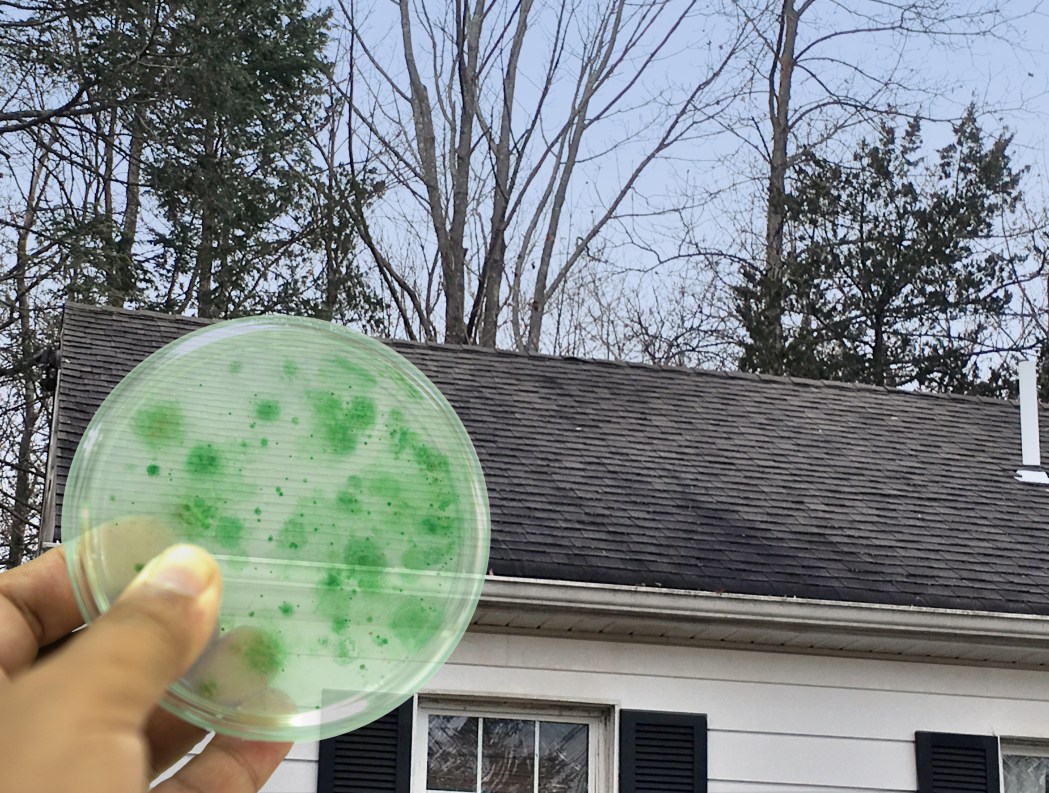
Those black streaks on roof shingles aren’t dirt, soot or a bad batch of shingles. They’re alive.
What looks like a stain from the street is a colony of microscopic organisms living on the stone granules of your shingles. It grows slowly, it spreads downhill with every rain, and it almost always starts on the side of the house that stays shady and damp the longest.
This guide puts a roof sample under the microscope. We’ll name the organism, show why some slopes streak and others don’t, explain how algae-resistant roofing fights back with copper, and walk through a cleaning plan that won’t strip the granules off your roof.

The streaks are blue-green algae, not dirt. Shade and moisture feed them, copper in the granules stops them, and a gentle, approved wash clears them. Never pressure-wash a shingle roof.
What’s In This Guide
What Black Streaks on Roof Shingles Really Are
Scientists have studied black streaks on roof shingles for decades. A study in the Journal of Phycology found that roof shingles are often colonized and discolored by blue-green and green algae. “Blue-green algae” is the everyday name for cyanobacteria, tiny single-celled organisms that make their own food from sunlight.
The Asphalt Roofing Manufacturers Association (ARMA) names the main culprit: Gloeocapsa magma, the species most often found behind black streaks on roof shingles across the country. You won’t see a single cell without a microscope. You see millions of them, packed together, as a dark smear.
Why black and not green? Researchers at the American Society for Microbiology describe the roof colony as a black biofilm whose cells are wrapped in a protective coating. That coating helps the cells survive hot, dry afternoons, then wake up again with the next dew or rain.
Why Shady Slopes Get Black Streaks on Roof Shingles First
The ASM team notes the black roof biofilm usually shows up on north-facing roofs away from full sun. Three conditions explain the pattern, and each one points to a fix.
That’s also why black streaks on roof slopes run downhill in stripes. Rain carries cells down the shingle courses, and the colony follows the water path.
Zoom In on Black Streaks on Roof Shingles
Turn the objective. Each magnification shows what you’d actually see at that distance, and what stops the problem at that level.
Dark Stripes From the Ridge Down
- What you see
- Long black streaks on roof slopes, heaviest on the north slope and under trees. The sunny side often looks clean.
- What stops it
- Sunlight and airflow. Trimming back branches lets the slope dry faster after rain and dew.
Streaks Follow the Water
- What you see
- The color is darkest where water drains and dew lingers, often below valleys, vents and the ridge.
- What stops it
- Metal washing downhill. Copper in the granules, or zinc or copper strips near the ridge, put algae-fighting metal in the water path.
It Lives on the Granules
- What you see
- A dark film coating the surface stones. The shingle underneath keeps its color; the colony sits on top.
- What stops it
- A gentle, manufacturer-approved wash that rinses the film away without scrubbing the granules loose. Never a pressure washer.
Clusters of Single Cells
- What you see
- Tiny cells in clumps, each wrapped in a protective coating. These are the cyanobacteria ARMA names Gloeocapsa magma.
- What stops it
- Copper released right at the granule surface. That’s the job algae-resistant roofing is built to do.
How Algae-Resistant Granules Stop the Stain
Every asphalt shingle is topped with colored stone granules. On algae-resistant roofing, some of those granules carry copper. ARMA explains that copper is incorporated into the granules, and that the right level of it blocks algae growth on the shingle surface.
The idea is simple. Rain and dew slowly draw tiny amounts of copper out of the granules and spread them across the roof. Algae cells can’t settle where that copper is present, so black streaks on roof shingles never get a foothold.
If you’re planning a new roof, this is the easy moment to prevent black streaks on roof shingles from the start. Our guide to durable roofing material compares how different shingles hold up, and our roof color ideas guide helps you pick a shade that suits the house.

On GAF Timberline HDZ shingles: GAF added Time-Release Algae-Fighting Technology, which GAF describes as specially engineered capsules that release copper steadily over time. Shingles sold in packages bearing the StainGuard Plus™ logo are backed by GAF’s 25-year StainGuard Plus™ Algae Protection Limited Warranty against blue-green algae discoloration.
Moss vs. Algae: Know Which You Have
Both thrive in shade and moisture, but they behave differently. Algae is a flat stain. Moss is a plant with body, and Oregon State University Extension explains that while moss doesn’t harm roofing directly, it holds moisture and debris that can shorten a roof’s life.
| Specimen | What it looks like | Main concern | First move |
|---|---|---|---|
| Algae | Flat black streaks on roof slopes, running downhill | Discoloration that spreads across the slope | Gentle, approved wash; copper granules on the next roof |
| Moss | Green, raised, spongy clumps, often along shingle edges | Holds water and debris against the roof | More sunlight; careful removal |
| Both | Streaks with green patches on a shaded slope | A roof that rarely dries out | Trim trees, then clean and inspect |
Why it matters: if you’ve been shopping for moss resistant roof shingles, remember that only sunlight solves the shade that invites both. If your roof has black streaks on roof shingles and moss together, the trees are usually part of the story.
How to Clean Black Streaks on Roof Shingles Safely
ARMA’s guidance is clear about the one thing to avoid: high-pressure washing should not be used for algae removal. Here’s the gentle approach, in order.
- Check your shingle maker’s instructions first. ARMA notes that cleaning solution strengths vary by manufacturer, and some warranties name approved methods.
- Protect plants and siding. Wet down landscaping and cover anything below the drip line before applying a cleaner.
- Apply a low-pressure solution. Treat the black streaks on roof shingles with a garden sprayer, never a pressure washer, and let it sit for the time the label gives.
- Rinse gently with plain water. No scrubbing. Brushes and friction can loosen the granules that protect the shingle.
- Stay off a wet roof. Treated shingles are slick. If the roof is steep or high, this is a job for a pro with fall protection.
Red Flags When Cleaning a Roof
- A pressure washer on asphalt shingles. ARMA warns it is likely to damage asphalt roofing.
- Hard scrubbing to “get it all.” Granule loss trades a stain for a shorter roof life.
- Zinc treatments near copper. Oregon State Extension warns not to use zinc on roofs with copper gutters, downspouts or flashing because zinc corrodes copper.
- A crew that can’t say what they spray. Ask for the product, the mix and whether your shingle maker allows it.
Keep Black Streaks on Roof Slopes From Coming Back
- Trim the treesOregon State Extension calls more sunlight the most effective long-term fix for moss. It helps against algae too.
- Keep the roof clearLeaves and needles hold moisture against shingles. Clear valleys and gutters each fall.
- Add zinc or copper stripsInstalled near the ridge, they shed metal as rain runs over them, the same principle as copper granules.
- Choose algae-resistant roofing next timeCopper in the granules works across every shingle on the roof.
Cleaning removes today’s colony. Prevention changes the conditions so black streaks on roof shingles don’t grow back. Start with sunlight, because it’s the only fix that works on algae and moss at once.
Metal strips are a reasonable add-on for an existing roof, especially one that streaked once and cleaned up well. Placing them near the ridge puts the metal where rain starts its run down the slope.
When the shingles are near the end of their life anyway, the cleanest answer is a full system with algae-resistant shingles. Our breakdown of roofing system components shows how the shingles fit with the leak barrier, underlayment, flashing and ventilation underneath.
The Takeaway Worth Sharing
Black streaks on roof shingles are a living colony, not dirt. Give it sun, rinse it gently and let copper keep it off.
Send this to the neighbor who’s about to rent a pressure washer.
Streaks on Your Roof? Let’s Take a Closer Look
Thrush & Son®: family-owned roofing and exterior pros since 1960.
If you’re in the Miami Valley and black streaks on roof slopes have you wondering whether to clean or replace, read the Thrush & Son® guide to how algae-resistant shingles stop black roof streaks, then book an inspection.
➡️ Schedule in Dayton➡️ View All ServicesCall (937) 833-5136 · 115 Jefferson St, Brookville, OH 45309
- GAF President’s Club Contractor
- Best of Dayton 2024 Winner · 2025 and 2026 Finalist
- BBB Accredited A+
- Since 1960


Further Reading
Official sources: the Journal of Phycology, the American Society for Microbiology, Oregon State University Extension, ARMA and GAF.
Roof Streak FAQ
What causes black streaks on roof shingles?
Colonies of blue-green algae, or cyanobacteria. ARMA names Gloeocapsa magma as the primary species. The cells live on the shingle granules and look black because of the protective coating they form.
Why are black streaks on roof shingles only on one side?
Algae grow where shingles stay damp longest. North-facing and tree-shaded slopes dry slowly after rain and dew, so they streak first, while sunny slopes often stay clean.
Can I pressure-wash roof algae off?
No. ARMA warns that high-pressure washing is likely to damage asphalt roofing. Use a low-pressure, manufacturer-approved cleaner, let it sit, and rinse gently without scrubbing.
How do algae-resistant shingles work?
Some of their granules contain copper. Rain and dew slowly release that copper across the surface, which keeps algae from settling. GAF Timberline HDZ uses time-release capsules that release copper steadily over time.
Is moss worse than algae on a roof?
Moss is usually the bigger concern. Oregon State University Extension explains that moss holds moisture and debris against the roof, which can shorten its life. Trimming trees for more sunlight is the long-term fix.
Written by Corey Thrush, Vice President and third generation of Thrush & Son®.
Leave a Reply