
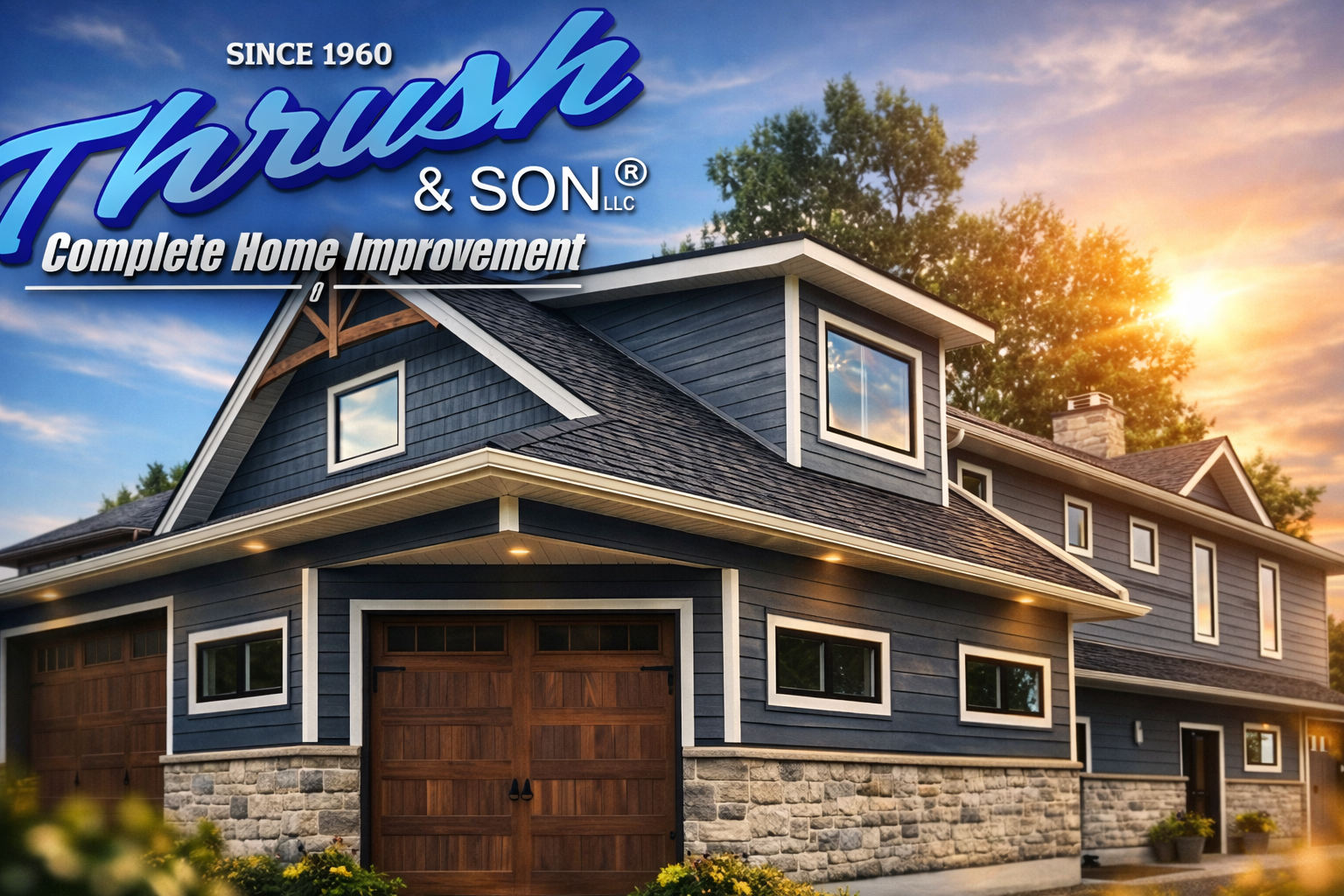
The types of vinyl siding you can choose from come down to one thing you can see from the street: the profile, or the shape each panel makes when light hits it.
Walk any neighborhood and you’ll spot them without knowing the names. Long horizontal boards on a Colonial. Tall vertical boards on a farmhouse. Staggered shingles tucked into a gable. Same material, completely different personality.
This guide works like the sample board in a siding showroom. You’ll learn the words on the label, flip through six profiles side by side, match them to your house style and compare the panels themselves before you sign anything.

Six profiles cover most homes: clapboard, Dutch lap, beaded, board and batten, shakes and vertical panels. Pick one main profile for the walls and one accent at most. Then compare thickness, insulation and certification, because two panels with the same look can be built very differently.
What’s In This Guide
How to Read the Types of Vinyl Siding
Every sample in a showroom is described with the same few words. Learn them once and the types of vinyl siding stop looking like a blur of similar boards. The definitions below follow CertainTeed’s siding terminology guide.
Profile
The outline of a panel seen from the side. It decides where the shadow lines fall, and the shadow lines decide the look.
Exposure
The width of each visible face, also called the reveal. Wider reveals read more modern. Narrower reveals read more traditional.
Face Count
Many horizontal panels are molded with more than one face, sold under names like Double 4 or Triple 3. One panel, several boards’ worth of look.
Texture
Woodgrain, smooth or cedar-cut. Texture changes how a color reads in low light, so judge it outdoors, not under showroom bulbs.
Two numbers apply across all types of vinyl siding. The InterNACHI life-expectancy chart lists vinyl siding at 60 years. And ASTM D3679 is the standard specification for rigid PVC siding, covering impact strength, wind load resistance, weathering and color uniformity.
In other words, the profile you pick is mostly a design choice. The way it’s built and installed is what decides how long it keeps that look.
Six Profiles on One Sample Board
Tap a chip to pull it onto the board. Each one shows the profile, the house styles it suits and how it behaves on a real wall. Together, these six cover the types of vinyl siding you’ll see on most homes.
Clapboard (Traditional Lap)
Horizontal · Double 4 or Double 5A tapered board that overlaps the one below, leaving a crisp shadow line at every course. The most familiar of all the types of vinyl siding.
Colonials, Cape Cods, ranches and traditional two-stories. A narrow reveal feels classic. A wider one feels relaxed.
Smooth faces rinse clean with a garden hose and a soft brush. Our vinyl siding cleaning guide covers the routine.
Dutch Lap
Horizontal · Grooved top edgeA flat face with a scooped groove along the top of each board, which throws a deeper shadow than plain clapboard.
Colonials, farmhouses and ranches where you want more texture without changing direction.
The groove collects dust and pollen, so give it an extra pass with the brush on wash day.
Beaded
Horizontal · Rounded bottom beadEach board ends in a small rounded bead along the bottom edge, a detail borrowed from older hand-milled siding.
Victorians, historic-style homes and porch walls where you want old-house detail.
The bead draws a fine double line, so straight, level courses matter. Ask to see a finished wall first.
Board and Batten
Vertical · 7 in. or 8 in. boardsWide flat boards joined by narrow raised battens, running up the wall instead of across it.
Modern farmhouses, gables and bump-outs. Read our board and batten siding guide for layouts.
CertainTeed lists 7- and 8-inch profiles, plus an insulated 10-inch board with a 2-inch batten.
Shakes and Shingles
Accent · Staggered coursesShort, staggered pieces that mimic milled cedar shakes or shingles, molded into larger panels.
Cape Cods, Craftsman and cottage-style homes, usually in gables, dormers or above a porch roof.
Staggered edges hold more dirt than smooth lap. A soft brush reaches the joints better than a sponge.
Vertical Panel
Vertical · Narrow groovesNarrow vertical boards with a fine groove between them, flatter and cleaner than board and batten.
Contemporary homes, entries and the wall above a garage door. CertainTeed notes some soffit panels double as vertical siding.
Long vertical lines show a wall that leans, so the installer should check the wall for plumb first.
One rule keeps a sample board from turning busy: one main profile for the walls and one accent at most. Two types of vinyl siding on one house can look custom. Three usually looks like a patch job.
Match a Profile to Your House Style
Architecture gives you a head start. Most house styles have one or two types of vinyl siding that look like they belong, and a natural spot for an accent.
Start with the lines your house already has. A steep front gable invites shakes. A long, low ranch wall can carry a wider lap. A tall, simple farmhouse form is made for vertical boards.

| House style | Main profile | Accent idea |
|---|---|---|
| Colonial | Clapboard or Dutch lap | Shakes in a front gable |
| Cape Cod | Clapboard | Shingles in the dormers |
| Craftsman | Wide-reveal clapboard | Shakes in the gables |
| Ranch | Dutch lap or clapboard | Board and batten on the entry bump-out |
| Farmhouse | Board and batten | Clapboard on a porch wall or addition |
| Victorian | Beaded or clapboard | Shingles in gables and towers |
| Contemporary | Vertical panel | Wide-reveal lap on one wall |
The tell: an accent goes where the house already changes shape, like a gable, a dormer or a bump-out. Put it on a flat wall and it looks like two houses stitched together. Trim does the stitching, and our exterior home trim guide shows how corners and window surrounds tie two types of vinyl siding together.
Standard, Thick or Insulated Panels

The profile is the look. The build is what’s behind it. Most types of vinyl siding come in more than one build, and the build drives the price and the feel of the finished wall.
Standard Panels
Single-wall rigid PVC made to ASTM D3679. A sensible fit for tight budgets, sheds, garages and small accent areas.
Thicker Premium Panels
A thicker wall feels stiffer in the hand. Ask for the nominal thickness on the spec sheet; CertainTeed lists .052 in. on its 7-inch board and batten.
Insulated Panels
Foam backing shaped to the panel, with its own ASTM specification, D7793. Our insulated siding guide covers the comfort side.
Whatever the build, look for third-party proof. The VSI Product Certification Program is an independent third-party program that certifies siding to ASTM standards, including D3679 for vinyl and D7793 for insulated vinyl.
Compare Types of Vinyl Siding Side by Side
Showroom chips are small and showroom lights are kind. Use these steps to compare types of vinyl siding the way they’ll actually live on your walls.
- Hold samples outside. Check them in morning and late-day light, on the side of the house they’ll cover.
- Step back to the street. A deeper profile still reads from the curb. A shallow one can flatten out.
- Read the spec sheet. Profile name, exposure, nominal thickness and certification, in writing.
- Price the same wall three ways. Standard, thicker and insulated, so the quote shows the real trade-off.
- See a finished house. Ask for an address where the same profile is already installed.
- Choose trim and color together. Corners, window surrounds and color frame the profile you picked.

Red Flags When Choosing a Profile
- Choosing from a tiny chip. A small sample hides how different types of vinyl siding read across a whole wall.
- No spec sheet. If no one can name the profile, exposure and thickness, you can’t compare quotes fairly.
- No certification on record. Ask whether the product is listed under the VSI Product Certification Program.
- Lead-safe rules skipped on an older home. The U.S. EPA requires certified firms for paid work that disturbs paint in homes built before 1978.
The Takeaway Worth Sharing
Choose the profile your house already suggests, then let one accent do the talking. The build behind the panel matters as much as the look.
Send this to the friend comparing types of vinyl siding.
Picked a Profile? Let’s See It on Your Wall
Thrush & Son®: family-owned exterior pros since 1960.
If you’re in the Miami Valley and weighing types of vinyl siding for your home, read the Thrush & Son® guide to vinyl siding styles, then book an estimate and see full-size samples on your own walls.
➡️ Schedule in Dayton➡️ View All ServicesCall (937) 833-5136 · 115 Jefferson St, Brookville, OH 45309
- GAF President’s Club Contractor
- Best of Dayton 2024 Winner · 2025 and 2026 Finalist
- BBB Accredited A+
Further Reading
Official sources: InterNACHI, ASTM International, the U.S. EPA and the VSI Product Certification Program.
Types of Vinyl Siding FAQ
What are the main types of vinyl siding?
Six profiles cover most homes: clapboard, Dutch lap, beaded, board and batten, shakes and shingles, and vertical panels. Many come in standard, thicker or insulated builds.
What is the difference between clapboard and Dutch lap?
Clapboard is a plain tapered board with a crisp shadow line. Dutch lap adds a scooped groove along the top of each board, which casts a deeper shadow.
How long does vinyl siding last?
InterNACHI’s life-expectancy chart lists vinyl siding at 60 years. Actual life depends on the product, the installation and how the house is maintained.
Can I mix types of vinyl siding on one house?
Yes. Use one main profile for the walls and one accent, placed where the house changes shape, such as a gable, a dormer or a bump-out.
What does exposure mean on vinyl siding?
Exposure, also called reveal, is the width of each visible face of a panel. Wider exposures read more modern, and narrower exposures read more traditional.
Written by Corey Thrush, Vice President and third generation of Thrush & Son®.
Leave a Reply