
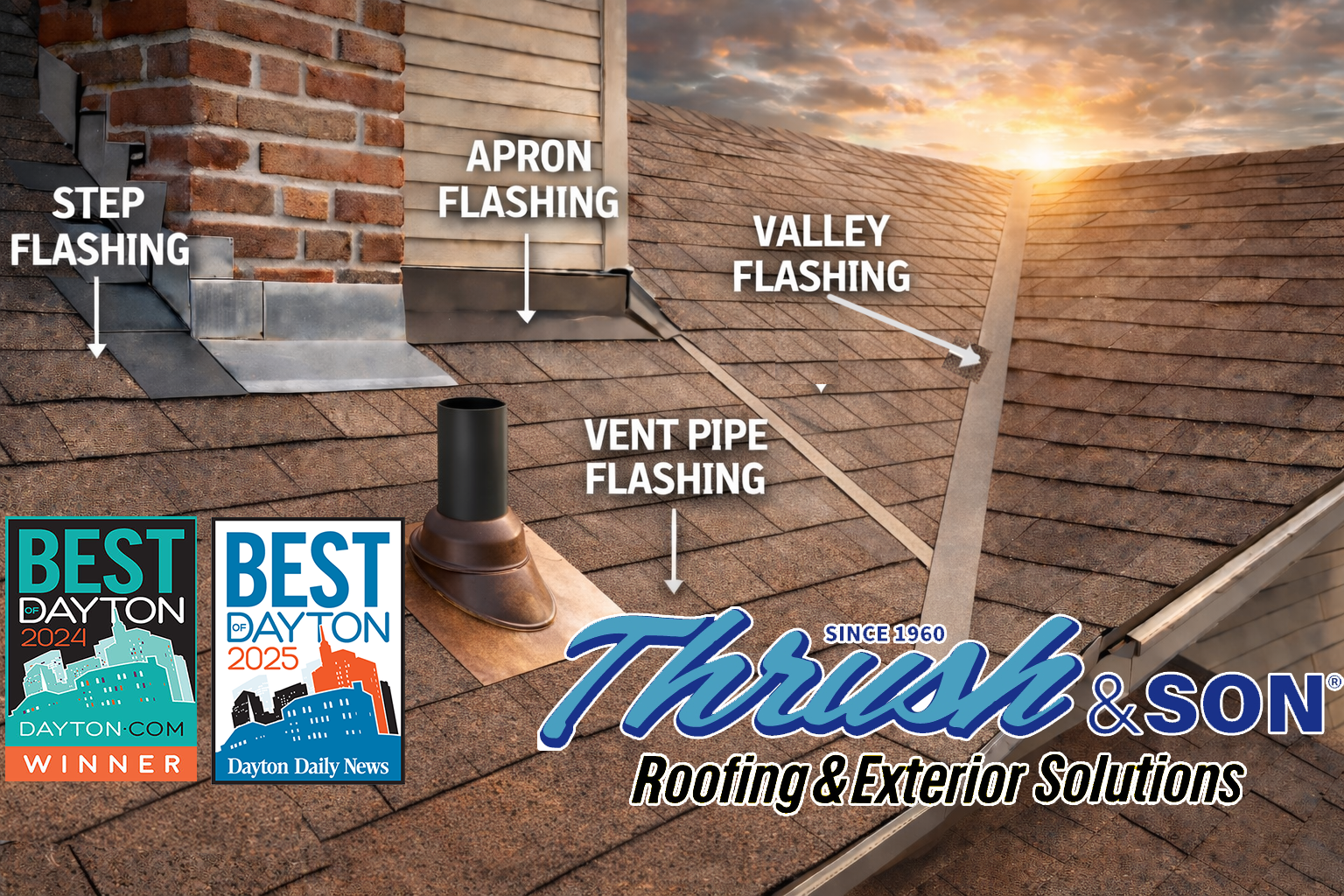
What is roof flashing? It’s the thin metal, and sometimes rubber, that seals every seam where your roof meets something that isn’t a shingle: a wall, a chimney, a valley, a vent pipe or the edge of the roof itself.
Shingles handle the open field of a roof. Seams are different: anywhere the roof runs into another surface, rain can slip sideways and find a gap. Flashing hands that water back to gravity.
This guide answers what is roof flashing by following the water. You’ll see how the laps work, watch nine types steer water in the Flow Lab, and learn what failure looks like.

What is roof flashing in one line? Metal that laps, not glue. Each piece sits so water runs over the piece below it, never behind it. Base flashing turns the corner, counterflashing covers its top edge, and diverters push water away from walls and into the gutter.
What’s In This Guide
What Is Roof Flashing, Really?
Think of a roof as a staircase for water. Each shingle course overlaps the one below, so rain only steps down. Where that staircase hits a wall or a hole, flashing builds the missing steps.
The Building Science Corporation flashing guide written for the U.S. Department of Energy sums up the whole idea in one line: “Gravity is the driving force behind drainage.” Layers lap so water runs over the lower piece, never behind it.
So what is roof flashing doing that caulk can’t? It moves water instead of blocking it. Sealant dries and cracks; lapped metal keeps working.

Lap Down the Slope
Upper pieces go over lower pieces, like shingles. Reverse one lap and water runs under it.
Two Pieces at a Wall
Base flashing turns the corner from roof to wall. Counterflashing laps over its top edge so water can’t get behind it.
Never Aim at a Wall
The DOE guide warns flashing must not steer water onto another part of the house. Diverters handle that.
Nine Answers to What Is Roof Flashing, One Junction
A roof runs into a sidewall and a back wall, with a chimney, valley, vent pipe and skylight. Tap a type to see what is roof flashing doing at that seam, where it sends the water and what failure looks like.
1 · Step Flashing
- Where it sits
- Along a sidewall. One L-shaped piece is woven in with each shingle course, each lapping the one below.
- Failure looks like
- Stains on the ceiling or wall right below where the roof meets the wall.
2 · Counterflashing
- Where it sits
- On a chimney or brick wall, set into a cut mortar joint or reglet, then bent down over the base flashing.
- Failure looks like
- Metal pulled out of the joint, or drips only in wind-driven rain.
3 · Apron (Headwall) Flashing
- Where it sits
- Where the top of a slope meets a wall. One long piece runs up behind the siding and out over the shingles.
- Failure looks like
- Peeling paint or swollen trim at the base of the wall, and stains below it.
4 · Chimney Flashing and Cricket
- Where it sits
- All four sides: an apron below, steps on the sides, and a cricket, a small peaked ridge, on the high side. Ohio requires a cricket on chimneys more than 30 inches wide.
- Failure looks like
- Stains beside the fireplace or damp framing around the chimney in the attic.
5 · Valley Flashing
- Where it sits
- In the inside corner where two slopes meet. It carries more water than any other spot on the roof.
- Failure looks like
- Ceiling spots along a diagonal line, or worn shingles down the center.
6 · Kickout (Diverter) Flashing
- Where it sits
- At the bottom of the step flashing, where the roof edge ends beside a wall that keeps going. It kicks water into the gutter.
- Failure looks like
- Streaks, rot or stains on the siding below the roof edge.
7 · Drip Edge
- Where it sits
- The bent metal strip along the eaves and rakes. It throws water clear of the fascia and into the gutter.
- Failure looks like
- Rotted fascia, a soft deck at the edge or stained soffit.
8 · Vent Pipe Boot
- Where it sits
- Around plumbing vents. The flange tucks under the shingles above and over the ones below; a rubber collar hugs the pipe.
- Failure looks like
- A round stain under a bathroom vent, or a cracked collar.
9 · Skylight Flashing Kit
- Where it sits
- Around the skylight curb: a sill piece, side steps and a head piece, like chimney flashing in miniature.
- Failure looks like
- Drips in the skylight well or stained drywall at the corners.
What the Residential Code of Ohio Requires
Part of the answer to what is roof flashing lives in state code. The roof chapter of the Residential Code of Ohio sets minimums for the seams that leak most.
| Where | The rule | Section |
|---|---|---|
| Chimney | A cricket or saddle on the ridge side of any chimney or penetration more than 30 inches wide | 903.2.2 |
| Sidewall | Base flashing must be continuous or step flashing, at least 4 inches high and 4 inches wide | 905.2.8.3 |
| Eave at a wall | Flashing must divert water away where the eave of a sloped roof meets a sidewall | 903.2.1 |
| Open valley | Metal lining at least 24 inches wide; galvanized steel at least 26 gage | 905.2.8.2 |
| Closed valley | A lining at least 36 inches wide under the shingles | 905.2.8.2 |
Valleys and Chimneys: The Two Big Funnels
If you’re asking what is roof flashing protecting most, start here. A valley collects two slopes of water, and a chimney blocks a whole slope.
Metal Shows Down the Center
Shingles stop short of a channel of exposed metal. Water and debris run off fast.
Shingles Cover the Lining
Shingles cover a hidden lining for a clean look. Ohio allows both when they meet the width rules above.
The Chimney Is Four Seams in One
A chimney needs every trick at once: an apron below, steps up both sides, counterflashing cut into the brick, and a cricket on the high side. Miss one piece and the others can’t cover for it.
Flashing is one of the seven parts of a shingle roof system in our guide to roofing system components. That guide shows the whole system; this one stays on the seams.

What Flashing Failure Looks Like
Water rarely shows up where it got in. Once you know what is roof flashing for, these clues point straight back to a seam.
- A stain beside the chimney. Usually chimney flashing or a missing cricket.
- Spots in a diagonal line. They often sit right under a valley.
- Rot below a roof edge on the siding. InterNACHI notes a missing kickout can cause severe wall damage with little visible evidence.
- Caulk instead of metal. Thick sealant often hides a lap that was never right.
- A round ceiling stain under a bath. That’s usually a vent pipe boot with a cracked collar.
Storms make these clues show up faster. If high winds just lifted shingles near a wall, read our Dayton wind damage guide, and check flashing whenever you walk through the signs of hail damage.
Check Your Flashing Without a Ladder
- Walk the walls. Look for streaks or soft siding below roof edges.
- Use binoculars. Check the chimney, boots and skylights for lifted metal or heavy caulk.
- Go to the attic after rain. A flashlight shows damp spots before they reach the ceiling.
- Ask about flashing on every quote. A new roof should list new step, apron, kickout and pipe flashing, not reused metal.

Once you know what is roof flashing supposed to look like, quotes get easier to compare. Flashing is a small line on the bill, but it’s where a roof earns its keep. For the shingle side, see our guide to durable roofing material.
The Takeaway Worth Sharing
Shingles cover the roof. Flashing covers the seams, and the seams are where water gets in. Lap it right and gravity does the rest.
Send this to the friend who just asked what is roof flashing.
Stain by the Chimney? Let’s Trace the Water
Thrush & Son®: family-owned roofing and exterior pros since 1960.
If you’re in the Miami Valley and wondering what is roof flashing doing on your own house, read the Thrush & Son® guide to the #1 roof flashing mistake, then book an inspection.
➡️ Schedule in Dayton➡️ View All ServicesCall (937) 833-5136 · 115 Jefferson St, Brookville, OH 45309
- GAF President’s Club Contractor
- Best of Dayton 2024 Winner · 2025 and 2026 Finalist
- BBB Accredited A+
Further Reading
Official sources: the Residential Code of Ohio, roof assemblies (Cornell LII), InterNACHI and the U.S. DOE Building America flashing guide.
What Is Roof Flashing? Your Questions
What is roof flashing made of?
When people ask what is roof flashing made of, the answer is usually galvanized steel or aluminum, with copper on some older or high-end homes. Pipe boots add a rubber collar, and valleys can also be lined with approved roll roofing or self-adhering membrane.
What is the purpose of roof flashing?
The short answer to what is roof flashing for: it seals the seams where a roof meets walls, chimneys, valleys, vents and edges, sending water onto the shingles or into the gutter.
How does roof flashing work?
It uses gravity and overlap. Each piece sits under the one above it and over the one below, so water always steps downhill. At walls, counterflashing covers the top of the base flashing.
Does a chimney need a cricket?
In Ohio, yes when it’s wide. The Residential Code of Ohio requires a cricket or saddle on the ridge side of any chimney or penetration more than 30 inches wide.
Should flashing be replaced with a new roof?
Usually, yes. Step, apron, kickout and pipe flashing are woven into the shingles, so new metal goes in with the new roof. Sound counterflashing on masonry can sometimes stay.
Written by Corey Thrush, Vice President and third generation of Thrush & Son®.
Leave a Reply