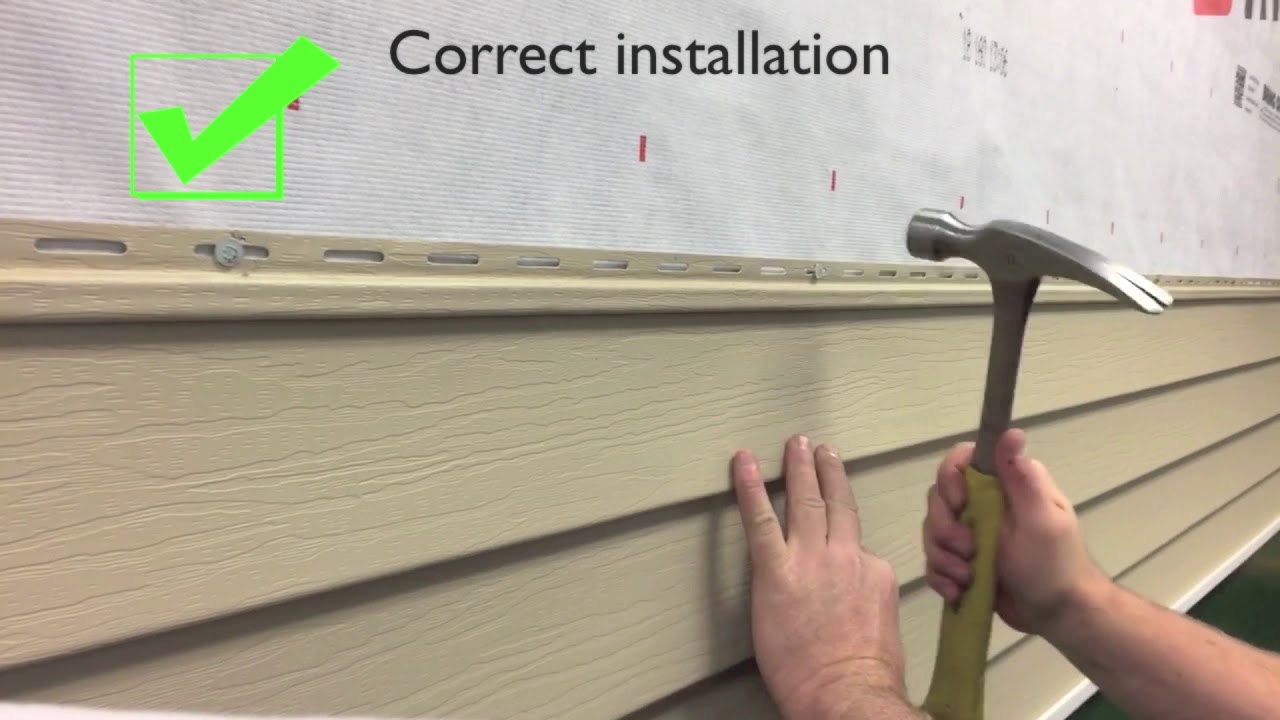
Most vinyl siding installation problems can be spotted from the yard, if you know that vinyl is supposed to hang loose and move with the weather.
Vinyl isn’t a board nailed tight. It hangs on nails and slides a little every time the sun hits it. When an installer fights that movement, vinyl siding installation problems show up on the wall: waves, buckles near the trim, gaps at corners and stains where flashing was skipped.
This guide works like a quality-control walk: why movement matters, six defects on a sample wall, cosmetic versus water risk, and the questions to ask an installer.

Most vinyl siding installation problems break one rule: vinyl has to float. Nails go in the center of the slot with a dime’s worth of space under the head, panels need room at every channel, and a water-resistive barrier plus flashing has to sit behind it all. Waves are a warning; missing flashing invites leaks.
What’s In This Guide
Why Most Vinyl Siding Installation Problems Start With Movement
The industry’s own Vinyl Siding Installation Manual says vinyl siding can expand and contract half an inch or more over a 12′6″ panel. That’s why the nails act like hangers, not clamps.
The manual is specific: center each nail in the slot, leave about 1/32 inch (a dime’s thickness) under the head, space nails no more than 16 inches apart on horizontal panels, and drive them straight and level. It warns that tight nailing makes siding buckle as temperatures change.
Nearly all vinyl siding installation problems come from breaking those rules or skipping the water-control layers behind the panels.
Figures: the Vinyl Siding Installation Manual and its horizontal siding chapter.
Spot the Defect: The Sample Wall
This wall has six common vinyl siding installation problems marked on it. Tap a number to see each one, why it happens and what to ask.
1 · Waves Across the Panels
Cosmetic firstSoft ripples in low morning or evening light.
Panels forced up or down while nailed, or nails not driven straight and level.
“Were panels hung without stretching, every nail centered and level?”
2 · Panels That Won’t Slide
Cosmetic firstA panel you can’t nudge sideways by hand.
Nails driven tight. The manual says panels must still move side to side.
“Do you leave a dime’s gap under every nail head?”
3 · No Room at the Trim
Cosmetic firstPanels jammed into the J-channel, bowing out on hot days.
Panels cut too long, with no 1/4-inch end gap.
“What end gap do you cut for on cold days?”
4 · Missing Window Head Flashing
Water riskStains under a window, or caulk standing in for flashing above it.
Flashing skipped or not lapped into the barrier behind the siding.
“How do you flash the top of each window?”
5 · No Kickout Where Roof Meets Wall
Water riskStreaks or stains below where a lower roof edge meets the wall.
No diverter at the bottom of the step flashing, so roof water runs onto the wall.
“Will you add a kickout flashing at every roof-to-wall line?”
6 · Gaps at the Corner Post
Water riskPanel ends pulled out of the corner post, leaving dark slots.
Panels cut short or not seated, so movement opens a path for rain.
“How deep do panels sit in the corner post?”
Waves, Ripples and Oil Canning

“Oil canning” is a term borrowed from metal panels for vinyl that looks wavy instead of flat. It’s the most visible of all vinyl siding installation problems. To check, stand at a corner early or late in the day and sight down the wall.
A few faint ripples on a long, sunny wall can be normal. Repeating bulges at nail lines, or waves that worsen every summer, point to vinyl siding installation problems in the fastening, not the vinyl. The manual also notes that floor-plate compression can buckle siding where the floor meets the wall.
Panel thickness and profile are worth a look too. A quote should name the exact product and line, not just “vinyl siding,” so you know what’s going on the wall.
Still choosing a panel? Our guide to the types of vinyl siding explains how profiles differ.

Cosmetic or Water Risk?
Not all vinyl siding installation problems carry the same urgency. Waves bother your eye; missing flashing can rot sheathing you won’t see until the siding comes off. Use this table to decide what to raise first.
| What you see | Likely cause | Risk |
|---|---|---|
| Waves or ripples | Stretched panels, crooked nails | Cosmetic first; watch it |
| Buckling near trim | No end gap, tight nails | Cosmetic first; can unseat panels |
| Face nails through the panel | Shortcut on the job | Cosmetic and movement |
| Open slots at corners | Short cuts, panels not seated | Water risk |
| Stains under windows | Missing or reversed head flashing | Water risk |
| Streaks below a roof edge | No kickout flashing | Water risk |
About face nails: the manual calls nailing through the face of a panel rarely appropriate, limiting it to spots like the last piece at a gable peak. Nail heads showing across a wall are vinyl siding installation problems that pin panels in place.
Questions to Ask Before You Sign
The easiest time to prevent vinyl siding installation problems is before the first panel goes up. These questions show whether a crew installs to the manual or to the clock.
- Are you VSI certified? The VSI Certified Installer directory lists people trained to fasten for movement and prep openings against water.
- How do you nail? Listen for “center of the slot,” “not tight” and “16 inches or less.”
- What goes behind the siding? House wrap, window flashing and kickouts should be in the written scope.
- Which product, exactly? Brand, line and color, plus the manufacturer’s instructions you’ll follow.
- Who fixes it later? Ask how vinyl siding installation problems found after the job are handled, in writing.
- Was the house built before 1978? The EPA requires lead-safe certification for paid work that disturbs more than 20 square feet of exterior paint.

The VSI directory also notes that improper installation can void manufacturer warranties. For timing siding with a roof or windows, see our order of exterior home improvements.
Red Flags That Should Pause the Job
- Half or more up front. The Ohio Attorney General lists large upfront demands as a warning sign.
- One estimate, no paper. The same office advises at least three written estimates, a simple guard against vinyl siding installation problems.
- No address, no references. A crew with no permanent place of business is hard to call back next summer.
- “We don’t need house wrap.” The manual says a continuous water-resistive barrier belongs behind vinyl.
- A nail gun set to sink every head. Tight nailing is the root of many vinyl siding installation problems.
Storm damage brings its own knocks on the door. Our Dayton wind damage guide covers what to check first.
The Takeaway Worth Sharing
Vinyl siding should hang, not be pinned. If it can’t move, it waves. If it isn’t flashed, it leaks.
Send this to a neighbor sizing up vinyl siding installation problems on a new wall.
Seeing Waves? Let’s Take a Look
Thrush & Son®: family-owned exterior pros since 1960.
If you’re in the Miami Valley and your wall shows any of these vinyl siding installation problems, read how our crews handle nailing and flashing in the Thrush & Son® guide to vinyl siding durability, then book a visit.
➡️ Schedule in Dayton➡️ View All ServicesCall (937) 833-5136 · 115 Jefferson St, Brookville, OH 45309
- GAF President’s Club Contractor
- Best of Dayton 2024 Winner · 2025 and 2026 Finalist
- BBB Accredited A+
Further Reading
Official sources: the U.S. DOE Building America program, the U.S. EPA, the Ohio Attorney General and ASTM International. Industry reference: the Vinyl Siding Installation Manual.
Vinyl Siding Installation Problems FAQ
What are the most common vinyl siding installation problems?
Nails driven too tight, panels cut without room to move at trim and corners, waves from stretched or crooked panels, and missing flashing or house wrap behind the siding.
How tight should vinyl siding be nailed?
Not tight at all. The Vinyl Siding Installation Manual says to center nails in the slot and leave about 1/32 inch, the thickness of a dime, under each head.
Why does my vinyl siding look wavy?
Waves usually come from panels that were stretched, nailed crooked or nailed too tight, so they can’t expand and contract. Low sun makes the waves easier to see.
Is wavy siding a water problem?
Waves are usually the cosmetic kind of vinyl siding installation problems, but they signal fastening mistakes. Gaps at corners, stains under windows or streaks below a roof edge are the signs that point to water risk.
How much gap does vinyl siding need at trim?
The manual calls for a 1/4-inch gap at corner posts and channels, increased to 3/8 inch when installing in temperatures below 40°F.
How do I find a certified vinyl siding installer?
Search the VSI Certified Installer directory, then ask for written estimates, references and a scope that lists house wrap and flashing.
Written by Corey Thrush, Vice President and third generation of Thrush & Son®.
Leave a Reply